Showing posts with label kawai novus nv10. Show all posts

Monday, 24 October 2022

Kawai Novus NV10 vs NV5 | Hybrid Digital Piano Comparison


Digital pianos have been around since the 1970s, and while they’ve been very popular for a long time among beginners, hobbyists and students, they’ve never really been considered a viable option for a discerning pianist.

Thanks to recent innovations in Hybrid digital piano technology, that’s no longer the case. In today’s video and article, we’ll be looking at two of the most advanced hybrid digital pianos currently available as we compare Kawai’s flagship models - the Kawai Novus NV10 vs NV5.

We’ve already done individual reviews for each piano, so if you’d like to see a hyper-specific deep dive into each piano, be sure to check those out. This article is instead designed to answer one question - which one should you choose?

We’ll be covering the exact differences between these two industry-leading instruments in the event that you’re in the market for a top-flight hybrid digital piano, whether as a replacement for an acoustic piano or simply due to the inherent perks of a digital piano, you’ll be able to determine which instrument will be a better fit for you.


Background Information: Kawai NV10 vs NV5

Our individual reviews of the Kawai Novus NV10 vs NV5 are among the most commented-on videos on our YouTube channel - there's no doubt that these pianos have elicited a ton of interest and excitement from prospective piano owners and enthusiasts. A detailed comparison between the two then should not only be useful but is probably necessary.

First, let's get into a general overview of the Novus series in the event that this is your first time coming across these pianos.

The Kawai Novus NV10 hit the market first and the whole idea here was this would be the first time Kawai would be incorporating a full acoustic piano action - the Millennium III Hybrid Grand piano action no less - into a digital piano, officially earning the designation of being a hybrid instrument.

This is the same acoustic grand piano action you’ll find in Kawai’s GL, GX and even Shigeru Kawai series instruments (the Shigeru’s of course receive a much higher level of refinement.) The only difference is that this version of the action has a synthetic felt hammer that passes through an IHSS optical sensor as opposed to a wooden hammer that strikes strings.

This action features ABS carbon fiber and extended-length wooden key sticks for maximum control.

It was around this time that their partnership with Onkyo began, which elevated their sound processing, amplifiers and speaker configurations to new levels of sophistication.

The NV5 followed more than a year later, and the reception seemed to eclipse the already highly regarded NV10 - our President and resident piano reviewer here at Merriam Pianos, Stu Harrison, actually has one at his home.

The NV5 uses a full-scale upright version of the Millennium III action - the same one you’ll find in acoustic upright pianos such as the Kawai K Series uprights like the K300 and K500.


Kawai Novus NV10 vs NV5 - Similarities & Differences

In both cases, we have modern acoustic piano actions interacting with advanced optical sensors which then send information, such as how hard or fast the key has been played, to a tone engine. In both cases we also have an Onkyo designed amplification technologies (including headphone amplifier) and speaker system delivering superbly clear tone and a room-filling 135 watts of speaker power.

The speaker systems themselves however are far from the same. On the NV10, Kawai has gone with a multi-speaker system consisting of four top speakers two dome tweeters on the top of the instrument, and two large woofers underneath the keyboard.

The NV5 has 4 top speakers and 2 dome tweeters as well, but instead of the woofers, it has the Kawai TwinDrive Soundboard Speaker System - this is a real solid spruce soundboard on the back of the piano with two Onkyo magnets driving it!

Due to these speaker differences, even though the power rating on these two instruments is the same as the tone engines, the playing experience is very different - excellent in both cases, but different.

Before we get too far into that, we need to devote some time to a discussion of the sound engine that both instruments share.

Kawai Digital Piano Sound - Speaker System & Sound Engine

Both the NV10 and NV5 are actually equipped with dual sound engines, the more intriguing of the two being Kawai’s new Pianist Mode SK-EX Rendering engine. This rendering piano sound engine combines multi-channel sampling (88 key individual) of the Shigeru Kawai SK-EX Concert Grand Piano with cutting-edge resonance modelling technology.

What this means is that Kawai has meticulously recorded their SKEX via multiple channels at a variety of dynamic ranges in every single note to generate a sample, which is then combined with acoustic rendering to recreate other sonic artifacts such as cabinet resonance and damper resonance.

With this sound engine engaged, the polyphony is unlimited courtesy of the modelling technology, which adds credence to the fact that this is Kawai’s most advanced sound engine yet. There are also 10 different Rendering Characters to choose from with different presets.

Kawai also makes their Virtual Technician feature available which allows the player to go in and edit adjustable parameters related to the tone, from minor tweaking of things like reverb to large-scale changes of hyper-specific parameters including things like aliquot resonance, key volume and undamped string resonance.

The secondary sound engine Kawai makes available here is the Harmonic Imaging XL engine, and this playing mode is referred to as Sound Mode. This engine offers you a large selection of tones such as ePianos, strings, organs, some very nice harpsichords and various other instruments.

This engine also offers 88 individually sampled notes but with 256-note max polyphony. While that may sound like quite the drop-off from the unlimited polyphony of the Rendering engine, in practice, 256 notes of polyphony are going to be enough for virtually all applications.


Convenient Features & USB and Bluetooth MIDI Connectivity

As we’ve mentioned, the brains on these two pianos are the same. Both pianos have a host of built-in piano music, as well as a large array of lesson songs. The cheekblock LCD touchscreen display is exactly the same and very easy to navigate.

In terms of connectivity, both pianos are USB to device as well as USB to host which lets you record locally (SMF and WAV files). There’s also Bluetooth audio as well as Bluetooth MIDI. Bluetooth Audio lets you stream and playback music from your smartphone or tablet directly through the piano’s high-end speaker system, dwarfing the sonic capabilities of anything outside of a legit audiophile home stereo setup.

Dual headphone jacks along with a 1/4” line in and a 1/4” line out round out the connectivity.

Both pianos have all of your expected functions such as dual, split, four hands mode and transpose as well as a metronome and a host of built-in drum rhythms.


Which Hybrid Digital Piano Should You Choose?

Why would somebody choose an NV10 over an NV5 or vice versa? Although, this question can probably be further distilled to be; why spring for the NV10? There is a significant price difference between these two despite many features being the same.

The first reason would be the action - while both are authentic acoustic piano actions, the NV5 has an upright piano action, while the NV10 has a grand piano keyboard action.

The geometry of an upright versus a grand piano action is of course quite different, and as such, these two actions do behave and feel different. If you’re looking for a true grand piano experience and substitute, the NV10 is going to be the better option for you. Dovetailing with this is the true grand piano damper mechanism you get with the NV10 with authentically weighted soft, sostenuto and damper pedals.

If on the other hand you really enjoy playing on a great upright action, you’re probably going to prefer the NV5 as your digital instrument hybrid.

The second big difference is how the sound is actually reaching your ear. These differences may not be pronounced in the video, but in person, they’re quite significant. That’s not necessarily to say that one sounds ‘better’, just different.

The sound on the NV10, as with a real grand piano, sounds more distant in a sense and there’s a large sense of room ambience as well. The treble also seems a little bit more dispersed.

Over on the NV5, the sound is much more direct, likely due to a set of tone ports located on top of the piano. This more immediate sound is really going to appeal to some players.

Of course, another reason they sound different is the presence of a solid spruce soundboard on the NV5 versus woofers on the NV10. The NV10 has a punchier bass, but the soundboard delivers a warmer bass on the NV5, and at a lower dynamic range, the bass response sounds much wider on the NV5.

So ultimately, this question really comes down to whether you prefer the immediate and more intimate tonal response of the NV5, versus a more distant sound with more ambient room tone (like a 6-foot grand piano) that the NV10 provides.

The upright versus grand action and the big tonal differences are probably the biggest reasons anyone would choose one over the other, but there’s another interesting consideration as well; the touch curve.

In our opinion, the NV10 requires a little bit more tweaking inside of the Virtual Technician function versus the NV5, which right out of the box has a more authentic touch response. This is likely due to differences in the factory settings.


Final Thoughts

Without question, these are two of the most advanced hybrid instruments available on the market today. Despite similar-looking specs sheets, however, they really do offer divergent musical experiences.

The Kawai Novus NV10 hybrid digital piano is really tough to beat if you’re looking for a true grand piano replacement without the maintenance requirements of an acoustic piano, while the NV5 is going to hit the nail on the head for people who love a great upright piano experience.

Both available in a striking ebony polish finish with slow-fall fallboard and large music rest, along with great warranty coverage, the piano shoppers of today are truly fortunate to have such incredible options to choose from.


Wednesday, 19 October 2022

Kawai Novus NV5 Hybrid Digital Piano Review


With the release of Kawai’s NOVUS NV10 hybrid digital piano, Kawai completely raised the bar in terms of what was possible as far as touch is concerned with a fully acoustic action in an otherwise digital piano. The main drawback of the NV10? The price.

When the Kawai Novus NV5 hybrid digital was announced, the hype and anticipation absolutely exploded. The NV5 being the upright piano entry in the NOVUS series that was set to cost several thousand dollars less than the NV10.

In today’s video and article, we’re finally taking a look at this new instrument that has been instantly met with rave reviews upon its release.

We’ll of course be covering the state-of-the-art action, sound engine and advanced speaker system, as well as the additional features and connectivity. Thanks for joining us - let’s get right into it.


Background

The NV5 hit the market in some other jurisdictions several months before arriving in North America, such as Japan and Europe. Needless to say, everyone over here at Merriam Music was keeping a close eye on new review videos and articles as they came out with extreme jealousy.

The first few shipments to finally arrive were all presold so it took us even longer to get one on the floor to try out. But when we finally did - wow!

But before we get into that, let’s cover some reasons why we were so excited about this piano in the first place. For starters, the level of hype and fanfare the NV5 immediately received, including many proclamations that it happens to be the finest digital piano ever produced, was really pronounced. Any successful new release garners a lot of hype, but the NV5 took this to a whole new level.

Our President and resident piano reviewer Stu Harrison was especially interested in trying the NV5 for personal reasons, namely that due to having a young baby at home, he’s been unable to spend much time playing his acoustic upright piano. This led him to ask - is the NV5 good enough to consider as a replacement for his beloved high-end German upright piano?


First Impressions

After his first couple hours on the NV5, Stu described his feelings as a mix of shock and surprise - the most musical experience that he’s ever had on a digital piano, bar none. He would ultimately end up trading in his German upright for an NV5 in the ensuing months.

Now, it’s important to note that we’re not saying that the NV5 is a superior instrument to a high-end German piano. But depending on your living situation, the flexibility the NV5 provides is ultimately more suited to a lifestyle with small children, and the NV5 delivers enough musical potential to be fulfilling.

Getting to play on a great acoustic piano action while being able to adjust the volume, and of course, playing with headphones can be a real motivator for certain people. And there’s a level of closeness and responsiveness that you wouldn’t normally expect to get out of an instrument that plugs into the wall.

At Merriam, we think this is the way of the future - eventually, we'll get to the point where most digital pianos are delivering a high-level experience like this because the world is heading towards a situation with increasingly smaller and smaller living quarters, thus necessitating a greater level of sound control and management that only a digital piano can provide.

Let’s move our discussion over to the sound engine.


Kawai Novus NV5 Sound

Pianist Mode: SK-EX Rendering Engine

The NV5 is outfitted with the same sound engines as the NV10 - SK-EX Rendering with multi-channel sampling while in Pianist Mode, and the Harmonic Imaging XL engine while in Sound Mode.

Multi-channel sampling with the SKEX engine means a Shigeru Kawai SK EX concert grand piano was recorded with more than just two channels as is the norm, meaning several microphones were used to capture the SKEX. After this, a variety of rendering characters and resonance modelling parameters are applied to the sample to simulate natural acoustic phenomena, such as damper resonance, cabinet resonance, aliquot resonance and even undamped string resonance.


Virtual Technician

There's so much colour and detail with this acoustic rendering sound engine, and you can actually go into the Virtual Technician mode and edit the parameters to further customize the sound to your own liking.

Parameters like the touch curve, soft pedal depth, key volume, stretch tuning, reverb, ambience and even the temperament key among many others.


Polyphony & Amplification

Polyphony is unlimited when playing in Pianist Mode, which means you’re going to play even the most complex classical works and never have a concern that notes will drop away.

There are 135 watts of amplification, which is a serious amount of power. 75% seems to be the optimal max volume you’ll want to play it, and that’s going to be plenty loud for home use.


Sound Mode: Harmonic Imaging XL

Over in Sound Mode with the Harmonic Imaging XL mode and we have a more conventional digital piano sound engine. There are a number of acoustic piano patches here including another SKEX recording, as well as all of the non-acoustic piano tones.

Despite a number of acoustic piano patches in the HIXL engine, it’s tough to see anyone spending a ton of time playing these patches instead of pianist mode unless you plan on doing a lot of layering.

Moving onto the electric piano tones, and many of these are very compelling, as are the nice selection of church organs.

Solid Spruce Soundboard System

Now, we need to address what’s happening with the speakers here, as this is a really big deal. We mentioned the amplifier wattage, but what’s really remarkable is that in addition to 6 traditional speakers (4 top speakers and 2 dome tweeters) is the presence of a real solid spruce soundboard speaker system driven by dual Onkyo transducers.

Because of this full soundboard on the back, the acoustic effect and sheer presence of sound, especially in a lower frequency register is just wild. Especially on organ patches, the power coming through the soundboard delivers a remarkable playing experience. We’re betting the NV5 will be hugely popular in the worship community due to how good the organ patches sound with this soundboard.

Sound Wrap Up

To summarize, the NV5 is delivering a truly singular sonic experience for a digital piano hybrid instrument. From the cabinet design to the sound engine, to the Twindrive soundboard speaker system, the NV5 will surprise even the most staunch purists when it comes to sound.


Piano Action

Millennium III Hybrid Upright Piano Action

Connecting you with all of that great sound is Kawai’s Millennium III Hybrid Upright Piano Action, and this is the first time a Kawai digital instrument has featured an acoustic piano keyboard action.

The only modification between this version of the action and what you would get with say a K200 is that instead of a hammer that has wool wrapped around it that strikes strings, this hammer crosses an IHSS optical sensor to determine the speed and how hard or soft you’re playing the keys.

Solid Spruce Extended Length Keys

When looking at the key sticks, these are solid spruce wooden keys that are also equal in length to what you’d find in a K200, offering an excellent level of control. The action is made of carbon fiber reinforced ABS so from a maintenance standpoint, this action is built to last.

The danger with the NV5, just as it is with the NV10, is setting the volume too low, which gives the perception that the action is quite heavy. Now, the NV5 manages this better than the NV10, but keep this in mind if you have the volume set to a low level.

The repetition speed behaves like a midsize upright, and there is a micro-texture on the keys for glide. As far as the regulation is concerned, there’s nothing to complain about as the action is clearly receiving a good amount of regulation at the factory.


Connectivity

On the left side of the NV5 just under the keyboard, you’ll find a panel with a whole bunch of connectivity options.

For starters, there’s a line out in the form of a stereo mini jack. If there’s one criticism here, it’s that Kawai went with a stereo mini jack as opposed to dual 1/4” line outs because odds are, lots of folks will want to use the NV5 on a stage, such as in a worship setting where discreet 1/4” outputs would come in handy.

After that, we've got a line-in which is also a stereo mini jack, so this input allows you run devices, such as an iPod, directly through the NV5. There’s also a headphone port with 1/4” and 1/8” inputs.

From there they’ve included old 5-pin in and out MIDI ports, as well as USB MIDI.


Bluetooth MIDI & Bluetooth Audio

The Kawai Novus NV5 is also equipped with both Bluetooth Audio and Bluetooth MIDI. Bluetooth Audio is especially nice here since it allows you to quickly and easily stream and playback music from a smart device through the NV5, taking advantage of its amazing speaker system and solid spruce soundboard.

In that sense, the NV5 can actually function like a super high-end Bluetooth speaker, and unless you have a serious audiophile set up at home, odds are the NV5’s speaker system will easily overpower your home stereo.

Bluetooth MIDI means you can transmit MIDI information wirelessly, or of course record MIDI and WAV files wirelessly as well.


Cabinet/Features

Gorgeous Ebony Polish Finish

The NV5 receives essentially the same cabinet as the Kawai K-200 acoustic upright piano, which means it looks the part of an upright piano with a beautiful ebony polish finish.

It’s also outfitted with a handy soft fall fallboard so there’s no concern about fingers getting pinched by the fallboard.


LCD Touchscreen

Navigating the NV5 is easy and intuitive thanks to the cheekblock LCD touchscreen. In fact, it essentially operates like the touchscreen on a smartphone so most users will already be familiar with this type of technology and will have no problem getting around the NV5.


Upright Piano Damper Mechanism

The Kawai NV5 has a pedal system built to mimic the exact nuances of a real upright piano damper mechanism. Real acoustic piano soft, sostenuto and damper pedals all weigh slightly differently, and Kawai has captured that exact weighting with the pedals here.

While this might seem like overkill, it’s actually going to be greatly appreciated by advanced pianists looking for a convenient practice instrument that offers the advantages of a digital piano while resembling an acoustic piano as closely as possible.


Final Thoughts

There you have it. Thanks for joining us for our rundown of the Kawai Novus NV5 hybrid upright piano.

Since the filming of the video, our company President and piano reviewer Stu Harrison has actually purchased an NV5 for his own home. He’s found that the flexibility to play whenever he wants in a home with young children has resulted in him playing much more piano than when he only had an acoustic upright piano, and he’s had no warranty issues whatsoever.

If you’re looking for the best possible recreation of an upright piano in a hybrid digital form, you owe it to yourself to seriously examine the Kawai Novus NV5.


Tuesday, 22 October 2019

Kawai Novus NV10 Hybrid Digital Piano Review & Demo by Merriam Pianos


Introduction

Welcome to another piano review, Stu Harrison is taking a fresh look at the Kawai Novus NV10 Piano - one of the piano industry's most ambitious examples yet of a manufacturer successfully simulating an acoustic grand piano experience with a hybrid piano. We'll be taking at the Millennium III Hybrid action with its optical sensor technology (this is a real grand piano keyboard action, for those just beginning their research), we're going to be talking about its piano sound engine, its cabinet, all of the features, everything that you get as a customer looking for a hybrid digital piano in the Kawai Novus 10. So thank you very much for being here. If it's your first time here, please do subscribe to the channel.

You'll be kept up to date with all things piano. And, of course, we love the support. So thank you so much for joining us. We're going to get started right away.

Background

If you're seeing this review in the first place, you've entered the world of hybrid digital pianos, and likely doing some diligent research. The Kawai Novus 10 has been out for some time - just over a year - and has certainly received lots of reaction over that time. So why return to do a second take on the instrument? I think when a brand new product first comes out, the hype and the initial reviews can influence your own impressions, and cloud you from truly getting a sense of what is there, which of course prevents you from giving a truly authentic review as well. After having spend many, many hours in front of the Novus 10 since that time, I thought that it would be helpful to share a second perspective. I think you're going to find this feedback helpful, or at least certainly, I hope you're going to find this feedback helpful.

Sound & Action

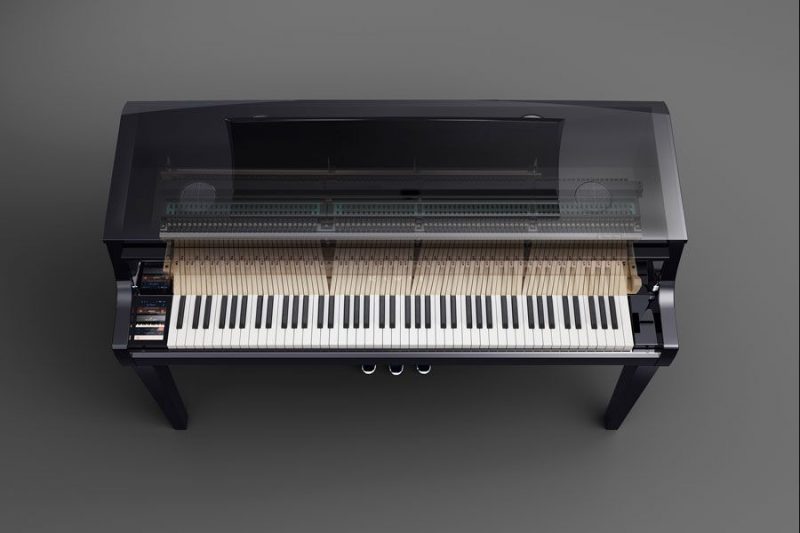
Kawai Novus NV10 Hybrid Piano Overhead

Let's start with the tone and the sound of this instrument. I usually split up action and sound into two separate categories when I'm reviewing a digital piano because, in a lot of cases, it's possible to talk about them as two totally separate entities. However, with the Novus 10 the integration of the two is so thorough that we can't really split up sound and tone when we're talking about the Novus. And one of the reasons why that is, is it's the first piano, a digital piano that Kawai has put out that uses a full acoustic action, named the Millennium III Hybrid Action. In fact, even the lid can be taken off just like as though it were a grand piano. And I can look at here and I can see the full key stick lengths. I can see the cap stands, I can see the jacks. It's remarkable to think that this doesn't look any different were I to remove the fallboard from a GX2.

The Hybrid Action even simulates the grand piano damper mechanism accurately, and as you look at the action outside of the Novus 10 cabinet, you realize that the only two things missing here is a string, and a wool hammer. EVERYTHING ELSE IS THERE. Some industry observers have compared Kawai's efforts here to Yamaha's Avante Grand action that you can find on the NU2 or NU3; and I'd agree that the approach is generally the same, however it then comes down to which action you prefer anyway, and who has done a better job of translating the physical motion of the key action into sound. There's no doubt that Kawai benefited from Yamaha being the first to tackle it, but in my mind Kawai has raised the bar with overall playing experience.

When I first encountered the Novus 10, I went through periods where I thought the action felt too heavy. I went through periods where it's like, "Ah, you know, this should be feeling more authentic than it does." Now, as I said, I've come back a week ago after really having lived with this for a long time and I've got some tips on do's and don'ts of really maxing out and enjoying what this Novus can do. Because I will say this unequivocally, once I figured out how to really get the Novus set up, this is the best digital piano I've ever played. This is definitely the closest to an acoustic experience I've ever come to. I've played pretty much everything on the market, but it took me a little while to figure out exactly how to achieve that sense of realism.

So, first of all, let's talk about the SK-EX rendering sound engine itself. So this is a multi-channel sampling of a Shigeru Kawai SK-EX concert grand. So that means that they are taking samples from different parts of the concert grand and those are being ported specifically to different speakers with some absolutely cutting-edge Onkyo processing. And if you're using the Onkyo headphone amplifier, you get their discrete spectramodule capable of Spatial Headphone Sound. They're also taking a multi-velocity sample. And in a first for Kawai, the Novus 10 in pianist mode has unlimited polyphony, revealing that there's actually quite a bit of modelling going on - not to mention a crazy level of memory and processing chops loaded in. When you compare the wav output of this machine to some of the previous top models, the structure and detail in the output is at an entirely new level of resolution - which if you're pushing that signal through insufficiently capable speakers or amplifiers, just gets lost - but in this case, nothing is wasted.

The subtleties with which all of these additional algorithms are contributing can't be celebrated enough. The acoustic rendering, resonance modelling, with all of their adjustable parameters, gives a shockingly accurate output. As we were listening to my recording of Hallelujah by Leonard Cohen on the Novus 10, if all you hear is the audio, it completely passes for an acoustic recording in every sense. It's the first time I've ever been fooled - normally there's some kind of giveaway...like hearing some stepping between sample layers, or an inauthentic repetition or a missed note at a moment where you wouldn't normally have heard one. It honestly came off as a real grand piano.

Once you're in sound mode, you are still getting the full power of the Harmonic Imaging XL engine, which by any other standard is excellent, and still provides a fantastic playing experience.

Sound Tips

Here's where I think people set themselves up to have a less than ideal experience on the Novus. And I realized this myself, and it's a pretty simple thing. First of all, you need to spend a bit of time to make sure that you actually get the piano tone that you want. There are so many parameters on this that are editable. You have a full parametric EQ that you can use. You can choose from a couple of different samples, you know, that you're going to be, kind of, starting from. Then you've got all of the 19 virtual technician settings that gives you the ability to, you know, really customize your own piano. If you don't spend the time to go through that and find a piano tone that you really resonate with, both figuratively and literally, it's going to fall short of your expectations. And anyone sitting down at the Novus, I think, is going to have sky-high expectations because of all the rhetoric that surrounds this instrument being, sort of, like the newest, latest, and greatest. So spend the time. If you don't spend the time, there's a chance you might love what's right out of the box, but if you don't, you're going to sit down expecting to be blown away and it might just not hit your ear the right way. So spend the time, it's 10 minutes in the virtual technician function as well as the various speaker and volume settings, and play through it. It's actually a really fun process.

The second thing I realized, though, is that this action, if played at 1/4 volume, feels heavy because you're invariably going to compare it to a real concert grand piano, or at the very least a decent baby grand, which would be giving you more sound for the same key pressure...and so your brain tells you "this is a heavy action". When you are giving more energy through your fingers than what you feel like your getting back through your ears, we perceive it to be a heavy action - regardless of what the actual physical resistance is on the key itself. And vice versa; when you have a piano where you get more sound back than you're expecting, for the level of force you're applying, you automatically ease off a bit, and perceive it to be a light action. So on the Novus 10, I found this effect to be extreme if you were anywhere under 50% volume and you weren't using headphones. This is going to take away from the overall enjoyment, and potentially cause you to have a poor first impression. Not to mention that the softer it is, the more you'll hear the key volume and overall mechanism itself.

Yes, I realize that I'll have people mentioning that this is exactly the situation that custom touch curves were created for. I would disagree, because even if you can get something that feels appropriate on the Novus, it's going to cause your muscles to train in all the wrong ways if you are also doing a lot of playing on a real acoustic. You don't want to have to be in chronic compensation mode.

So my advice is if you're in a situation where you have to be playing quietly and you've got a Novus 10, or you're considering a Novus 10, get yourself a really good set of headphones and take advantage of all of that processing, that Onkyo processing that's there for headphone use and then turn it up as loud as you want so that you're getting the proper experience. If you're using the onboard speakers and you're using at a quarter volume or half volume, I guarantee you this action is going to feel a little bit weird and it's going to feel heavy. If you turn the volume up, maybe not all the way to max, but, you know, at an 8 out of 10 or something in that range, then you actually hit the dynamic range, the dynamic envelope that starts to resemble like a 5-foot piano. And then all of a sudden, as if by magic, this action starts to feel light and it starts to feel effortless.

The thing is, the action is so accurate that that doesn't mean you're not going to be able to draw really, really soft tones out of the piano.I have the volume set to about 9 out of 10 right now. And that action feels like in front of a real baby grand piano.So that, yeah, I've just turned it down to about a 6 out of 10. And my perception is that that action is starting to get a bit heavy. I've turned it down to about a 4 out of 10, and now my ear is hearing the mechanic of the action and it's feeling heavy. So the illusion of being behind an acoustic piano is now totally broken. And I haven't even turned it down below four.

Like I said, I don't necessarily see this as a fault of design. You're trying to mate an action that has, you know, 52, 53 grams of weight, which is way heavier than most digital instruments, but you've loaded this instrument up with like 135 watts of output power. So it's got the juice to match this dynamic output with the force that you're used to putting into a Millennium III Action. But if you're going to turn it down to three or four, it's going to feel mismatched. And maybe in subsequent generations of Novus 10, they're going to be able to accommodate for this somehow. But at this point, my advice, strong advice, if you're sampling this or if you own this, if you're playing at a 3 or 4 out of 10, just plug the headphones in and then put it up to a volume that really feels comfortable. I would say at least at a 6 out of 10, and you're going to have this nice mating of the action with the sound, or if you don't have to worry about the sound, don't be afraid to put it to a 7 or 8 because the dynamic control that you're getting out of this action is just exquisite.

Cabinet, Speakers, and Pedals

NV10

The speaker / sound reproduction system is quite unlike anything else that Kawai has. You've got four top speakers on the top of the instrument, two of which are not covered by the music desk (sometimes referred to as the music rest), two of which actually become covered by the music desk when you lean this down. Included in these are dome tweeters which pump out crystal-clear treble. Placing two of these where they could be covered by the music desk I have to assume has been done on purpose to simulate closing of a real grand piano lid. So if you want to close the lid but still have your music desk, Kawai has equipped this with actually two separate levers. So you can adjust this so that it sits 'half up' (enough that it's still functional) partially obstruct the speakers. Or, of course fully raise the desk for the complete sound of all four top speakers. And then that's going to give you the simulation of the lid completely open and it actually does change the sound as it's reaching your ear. It's an interesting, well-conceived feature.

Then you've got your main speakers underneath - two primary speakers and one woofer to give true lower harmonic presence. All in all, one heck of a powerful and well-balanced speaker system - with no less than 135 watts of power. Controlling those speakers, you've got a multitude of effects processors, amplification technologies, reverb engines. There's something that's called Wall EQ; if you've got it backed right up to the wall it automatically adjusts the speaker output and EQ curve so that you don't get ugly reflections. The cabinet has also been designed to give true cabinet resonance, so that even the frame and polyester are doing their part to deliver an authentic piano experience.
As for the cabinet, there is certainly some inspiration taken from the Yamaha predecessors, but thankfully far from a straight rip-off. The NV-10 is its own beast for sure. The triple pedals function as expected: sustain / damper, sostenuto, una corda (soft pedal), but also the Grand Pedal Feel System which mimics the individual spring tensions that you find on a real concert grand piano. The cabinet also features a genuine soft fall fallboard, real cheekblocks, with the brand-new LCD Touchscreen Display buried right in the left side - an enhancement to the user interface that Kawai has nailed in grand fashion this time around.

I love the design of the instrument. I mean, it evokes a grand piano, but it's nice and compact. You're not wasting any space, sort of, trying to emulate that curve, which on a digital grand piano is nothing but aesthetic. It's not really serving any functional purpose. And so, I like this for its compactness, but also for its uniqueness and its elegance.

Bluetooth & Connectivity

NV10-Touchscreen-Display

In addition to the exquisite sound production, action, and cabinet, we've got Bluetooth MIDI. We've got Bluetooth audio. So if you want to hook up your phone, or your iPad, or any sort of a mobile device and play your music through the stereo, you can and it sounds unbelievably great, and an additional way to take advantage of the premium audio processing that the instrument has onboard.

The "docking station" underneath the piano has every port you could hope for, including line in and line out connectors (both with 1/4" stereo jacks), headphone jacks of both sizes, and USB ports so that you can get SMF files on and off easily. And then you've got a nice, kind of, docking station underneath where you've got audio ins and audio outs through a quarter inch. You've got your USB ins and outs. So you can, you know, plug a USB key in there or, you know, hook it wired up to a computer to use it.

Conclusions & Summary

By and large the main purpose of this instrument is to give a player as uncompromised a playing experience as possible in a digital piano, while coming as close as possible to a real acoustic grand piano. I say with more confidence than ever that the Novus 10 does that better than anything on the market today.

There's a wide variety of reasons why acoustic baby grands just don't work for some people. Obviously, footprint is an issue, but climate control is also an issue. And I would also include professionals looking for a reasonable recording option where they don't want to use software and a controller, or don't have the option to mic up a 6 - 9' grand themselves. As I said, please check out the playing videos we've done of these to see just how true the rendering characteristics are.

Thank you very, very much for giving us a few minutes of your time, and good luck with all of your shopping and research. Please subscribe to our Youtube channel to be kep up to date on all things piano, and of course new video material.


The post Kawai Novus NV10 Hybrid Digital Piano Review & Demo by Merriam Pianos first appeared on Merriam Pianos