Showing posts with label steinway. Show all posts

Monday, 9 January 2023

Piano Buying Tips: 10 Common Mistakes People Make When Buying A Piano

Piano Buying Tips - 10 Mistakes to Look Out For

Purchasing a first piano can be fairly intimidating, especially if you don’t already have a lot of experience with pianos.

Fortunately, here at Merriam Pianos, we’ve seen the piano purchasing process through with literally thousands of customers since our inception, from beginners to concert-level piano players, so we can safely say we know a thing or two about what people ought to look for when buying a piano.

Today, we’re going to tackle the 10 mistakes shoppers often make when buying a piano. We feel this list should be helpful to anybody who's embarking on the process of selecting an instrument for their home, school, church, studio or wherever it may be.

Avoiding these common mistakes will go a very long way in ensuring your long-term satisfaction with the instrument you end up choosing.

Mistake #1: Used is Better Value than New

The very first mistake is a common assumption many people make, which is that a used piano is automatically a better value than a new piano.

While there are cases where this is true, most of the time the overall marketplace has already factored in the value a buyer is getting for used versus new - as long as you understand the street price versus the list price of a new piano that you’re looking at, you'll simply be getting what you pay for.

For example, a used Yamaha U1 in a certain age category has a particular market price point that’s been largely set due to the fact that any used piano performs at a certain level markedly lower than a new counterpart.

If a new 48-inch Japanese piano is worth $9,000 to $10,000, the cost of a used model directly dovetails with this and will be anywhere from 1/3 to 2/3 depending on age and condition.

The main reason for this is that all pianos degrade, depreciate and wear out over time, without exception.

There is no such thing as a 20-year-old piano that is as good as a brand-new piano, with the exception of those rare barn finds where someone unearths a 20-year-old instrument that was never played. Obviously, something like this would be a killer deal, if you could find one.

In most cases, a used piano has received hundreds and even sometimes thousands of hours of use. The hammers are harder and have started to wear down, plus there's more play in the hammer action, meaning it’s going to be looser and less responsive.

The soundboard will have already received decades of down-bearing tension, which affects the soundboard crown, which in turn affects the dynamic potential of the sound.

Tuning stability may also be sub-optimal due to a variety of reasons, such as the humidity of the environment in which the piano is stored. The piano technician/tuner bills can add up quickly.

Finally, the aesthetic condition of a used piano is pretty much always going to be inferior to a new piano unless the instrument has been refinished.

However, this can be costly and would be reflected in the price. For most people, when they invest several thousand dollars into an instrument, they rightfully want it to look good.

All of that put together is to say this: when it comes to used versus new pianos, you get what you pay for.

New pianos are more expensive due to their superior musical potential, aesthetics, durability and warranty coverage. Used pianos cost less, and in the case of many Spinet pianos are available for free, for a reason.
 

Mistake #2: Buying Based on a “Discount”

This is another one we see all the time - the allure of a big percentage discount from the list price set by the manufacturer. This is an old sales technique that stretches across many industries, automobiles being the most common.

The piano industry is certainly not immune from this, and there's been a lot of good ink spilt on this subject over the years - Piano industry expert Larry Fine for example has opined on this with a great level of detail in several of his highly credible publications.

Here’s what this mistake comes down to; MSRP stands for manufacturer-suggested retail price, and is 100% set by the manufacturer without measure against any type of objective standard.

In the marketplace, there seems to be an inverse relationship between a piano's reputation regarding quality and how high or low the MSRP is.

The better the piano, and the more established the reputation of that instrument, the closer MSRP is likely to be to the actual legitimate street market price of that instrument, to the point where some instruments literally have no daylight between MSRP and what people are actually paying for these pianos.

For many decades, you could say that Steinway & Sons was the only manufacturer who achieved this, but these days there are a number of other manufacturers marketplace who have achieved this as well.

Estonia for example has set their MSRP very close to what the market actually pays for their good high-quality pianos, meaning they haven’t artificially inflated the MSRP to a point where dealers have an abundance of room to discount.

On the flip side of the equation, situations exist where lesser-known and lower-quality brands often dramatically inflate the MSRP of their pianos to achieve two things; for one, they're looking to achieve the perception of equivalence with much more established brands, by listing a high MSRP to artificially inflate the value.

Secondly, this gives less experienced and less established dealers a sales tool that can be effective at generating excitement, i.e. a large, time-limited discount.

This is a common tactic with lesser-known Chinese and Indonesian lines. Very rarely do you see this approach occurring with either North American, European or good-quality Asian-built pianos.

The market pricing is so well-established that people's impression or need for a sense of credible pricing on these instruments handcuffs the manufacturers in a way that is advantageous for consumers.

So, don't be allured by a super high discount based on MSRP from a slick salesperson because there's a very good chance that if you're getting something like 50% off the list price, this MSRP was artificially inflated in the first place.
 

Mistake #3: Underestimating a Piano’s Volume

Do not underestimate how loud a piano is!

We can’t tell you how many times every single year we get a call from a customer who was thrilled about their piano purchase only to receive delivery and a couple of weeks later be begging for some type of a solution due to the sheer power and volume a piano generates, especially when you dig into the key action and have the sustain pedal engaged.

Pianos are loud. They were built to be loud, and there’s no way around this.

Don't underestimate this and instead, actively plan for it. If you're in a small space or if you've got neighbours, carefully consider the size of the piano because size has a direct relationship to the volume that it produces.

You can also consider other mitigating strategies such as installing a silent system or going with a top-tier hybrid piano that’s actually able to produce a musical experience on par with a fully acoustic piano.

Mistake #4: Not Measuring Piano Size Correctly

This one might seem obvious, but just as often as we have people calling and looking for strategies to mitigate volume they weren't expecting, we get even more calls about this one - the piano won't fit. Measure!

This comes up a lot when we're talking about getting pianos into or out of basements and onto second floors.

Pianos are large and heavy so you need more than a centimetre of clearance to safely move one up and downstairs.

If you have measured at the music store and it's literally going to be within an inch, there's a very good chance that you are going to be taking on damage to the instrument itself or to the walls of your home.

This should be an expectation, and it is not a reflection on the moving company that you have selected if a problem occurs.

The vast majority of piano movers really care about the work they do, and often times issues arise simply due to folks having selected a piano too big for its desired end location.
 

Mistake #5: Allowing For Acclimatization

This next one has less to do with a shopping mistake and more to do with a misconception right at the same time as a shopping purchase.

Acoustic pianos, not so much digital pianos, need to acclimatize. There is a huge amount of tension on an acoustic piano, and the primary materials, wood and iron, are prone to shrinking and swelling with changes in humidity and temperature.

The humidity and temperature in a warehouse will be different than the humidity and temperature in a piano showroom, which in turn will be different from your home.

When the piano finally arrives in your home for the first time, there will be a period where the instrument goes through some changes while settling into the new environment.

This process often results in piano keys that are slightly sticky or at least a little stiffer than you might expect them to be. You may also find some ringing on certain strings, or a damper that isn't quite damping perfectly.

These are all signs of an instrument that is generally acclimatizing.

It's certainly a good idea to notify your dealer if these things occur shortly after delivery, but your first reflex should not be to think that you have bought a lemon as this is very common. and stretches across all piano brands and types of pianos.

If the humidity continues to be quite dynamic in your home, you can expect a lot of these behaviours to continue.

Creating a humidity environment that is stable can go a long way in preventing these issues from occurring, but even if they do, there’s no need to panic. Just keep in touch with your dealer and they can get the issues remedied.
 

Mistake #6: Not Considering The Mechanical Sounds Of A Silent System

This is one that wouldn't have needed mentioning even 10 years ago, but the increasing popularity of silent pianos has changed this.

And it makes perfect sense - people want to be able to enjoy all of the sound quality of an acoustic piano without making enemies of their friends, family, and neighbours.

With that in mind, it’s not surprising that we're seeing so many silent systems installed on acoustic pianos since the technology has really evolved in the last few years.

But here is what you need to keep in mind; the mechanical sound of a piano's action is anything but silent.

While the 80 decibels of tone that the piano produces due to the hammer striking the strings is eliminated, the marked mechanical noise that the action itself produces can’t be done away with.

Plus, most silent systems still have the hammer striking some type of bar which also produces noise.

With this in mind, we would encourage anyone considering a silent system to make sure you play one in a piano store and pay attention to the mechanical noise that isn’t done away with by the silent system.
 

Mistake #7: Buying Based On A Country's "Sound"

Often times we have customers visit one of our showrooms and the conversation starts something like this "I hate Japanese pianos, they're too tinny and the American sound is just a little too brash for me. I really prefer the high-quality European piano sound."

The problem here is that countries don't really have sounds. There is as much variety in the German piano-making industry as there is in the Japanese piano-making industry for example. Instead, countries have general quality standards that can translate to musical perceptions.

When you are competing in a marketplace where your consumer is accustomed to a particular standard of quality, you will generally find that all manufacturers will rise to the occasion. Otherwise, they simply won’t be able to compete.

Europe is steeped in musical culture, and as such the standards that the buying community apply to the piano manufacturing business are higher than buying audiences where the level of musical fluency isn't as well-established over multiple generations.

As such, German pianos generally are the best made, and the better made a piano is, the cleaner the sound will be.

Under that umbrella though, there’s a huge variety of tonal colours and palettes that are possible.

As a result, there are both light and dark pianos from Germany, as well as super colourful pianos and pianos with a very simple tonal profile.

The main thing they have in common is excellent craftsmanship resulting in cleanness of tone.

In terms of pianos from the United States, while there still are 3 US-based piano manufacturers, the classic American sound really just means the Steinway sound, as opposed to the Baldwin or Mason & Hamlin sound.

Japanese pianos are either going to be from Kawai or Yamaha, and these two manufacturers offer pianos that sound widely different from one another. To say there is a Japanese sound isn’t really accurate.

To summarize, while countries have generally consistent quality levels, the idea that all pianos from one country sound the same is not accurate.
 

Mistake #8: Assuming All Grands Are Better Than Uprights

Here’s another one that comes up all the time - shoppers assuming that baby grand pianos are always superior to upright pianos.

The fact is, grand pianos are not automatically better than upright pianos, plain and simple.

In fact, there are many instances where the quality of the materials and the execution of design on an upright piano will produce a more preferable musical experience than a grand piano of the same price.

This is a general guideline, but we have often found that if you’re seeking a grand piano with exactly the same fit and finish, material quality and design sophistication, you need to approximately double your budget from what a comparable upright piano would cost.

For example, if you were looking at a $20,000 upright piano, you would have to jump to approximately the $40,000 or $50,000 price range to get a grand piano that would be of equal overall quality.

Now, the aesthetics of a grand piano are unbeatable in a living room and the physics of the action come with their own benefits that may mean an otherwise lesser quality grand piano will still be a better piano for you, especially if you’re serious about advancing through piano lessons.

But don't assume that simply choosing a grand over an upright, in all cases, is always going to produce a superior musical experience.
 

Mistake #9: Not Considering Uprights Under 48 Inches

This one is a classic. Many people think they shouldn’t entertain an upright piano under 48” in height if they’re going to be doing the serious playing, likely due to something they heard from their piano teacher.

This idea likely came from the fact that the Yamaha U1 is 48” in height and is by the far the best-selling upright piano in North America over the last few decades. In Germany, the most common upright piano size is about 47” in height, so this belief simply doesn’t exist in the mind of consumers there.

The 48” mark is in reality arbitrary. If you automatically draw this line in the sand, you’re cutting yourself off from some fantastic options that come in under this mark.

The fact is, there are many excellent upright pianos available as small as 43”, so we would recommend considering uprights of all sizes.
 

Mistake #10: Shopping Dynamic

The very last item on our list is a little bit touchy, but we’ve seen this derail the shopping process many times and that is having convoluted decision-making dynamic.

Of course, there’s nothing wrong with different family members or a buying group making the final decision of which piano to go with, and having a strong degree of feedback will help in narrowing things down.

But once things have been narrowed down is where having multiple decision-makers can be quite problematic. Choosing a piano after you've made sure that you're in the right category and working with the right budget is extremely personal.

Somebody needs to be designated to take the lead at the very last stage and be the one to musically crown the winner. We’ve seen the entire process gets entirely derailed when there are too many cooks in the kitchen, so to speak.

It’s highly recommended that the person whose primarily going to be playing the instrument have the final say. After all, they’re the ones who will be spending countless hours in front of the piano when all is said and done.

Closing Thoughts

We hope you’ve found this article helpful. As we said in the intro, we at Merriam Pianos have helped thousands of families and individuals choose a piano over the years here at Merriam Pianos, and the above-listed 10 mistakes are extremely common.

If you’re able to avoid the mistakes we’ve listed, the odds greatly increase that you’ll end up with the right piano for you, whether you’re getting ready to learn piano for the first time, or highly experienced pianists and everything in between.

Thank you for reading our piano buying tips and happy shopping!

The post Piano Buying Tips: 10 Common Mistakes People Make When Buying A Piano first appeared on Merriam Pianos

2359 Bristol Cir #200, Oakville, ON L6H 6P8

Wednesday, 19 October 2022

Upright Piano Buyers Guide | How to Choose an Upright Piano


When it comes to acoustic pianos, there are a lot of 'best of' lists and new piano buying guides out there with a ton of different information on different models. What these lists tend to neglect is a systematic way that you, the buyer, can sort through this information and zero in on the most important considerations affecting your decision.

In today's article and video, we're going to list the things you should be considering when looking for an upright piano and placing them in a very specific order of importance. We've already done the same thing for digital pianos, and we received positive feedback that people really found that helpful.

We're confident that if you apply our formula to your shopping process, you're not only ensured to be thrilled with the piano you end up with, but you'll also do so in much less time.

Piano Dimensions

The very first thing that we're going to suggest you start with is size. Not budget, not country of origin, but size. Here's why. The size of an upright piano directly determines its volume and the fullness and clarity of the bass register. It doesn't matter how well a piano is made - If it's not loud enough or it doesn't have a clear enough bass, there are no other factors that can ever make up for that.

There are upright pianos that can be as small as about 42" in height, and they generally get to be as tall as about 53" with sostenuto pedals. Although that only sounds like about a 20% difference, the proportional difference in string length is actually much larger. This is why that height difference can have such a big impact on how full the tone is and how much sound you need the piano to produce.

Be careful if you're looking at a small used piano as you'll want to ensure it isn't a Baldwin Spinet model - these instruments feature highly antiquated action designs and should be avoided.

There are several factors which might influence your needs in this area. One could be the size and acoustic makeup of the room where you'll be placing your piano. If you're planning on putting your upright piano into a very large space with high ceilings, you might have the need for a larger piano. If you're going to be recording with this instrument, you'll probably desire strong bass clarity, so you're not going to want to go lower than about 47" in height for example.

What are the risks here if you pick the wrong size piano? If you pick a piano that's too small for your needs, you are going to be training yourself to operate an instrument that behaves very differently than other pianos that you might experience out there. This is more of a consideration for students and professionals who might be doing recitals or performances on a concert grand piano, which offers an experience that is very different than that of a small upright.

If your needs really are a 48" upright, then don't go looking for a 42" by trying to exchange size for a more high-quality instrument - if you need a taller instrument, don't compromise here.

Sound Quality and Tonal Profile

After you've established the size that's appropriate for you, the next thing you'll want to focus on is picking a tone that satisfies your ear and excites your musical soul. Sometimes we can't explain why we like the tones that we like, but the point is, you want to pick something that is going to truly excite you and make you want to play.

Several things go into what gives a piano its tone. Country of origin can have an indirect influence because certain countries' piano industries are known for construction practices, designs, and overall quality control. If you buy a piano from Germany, you know that you're going to get a piano with great tonal clarity due to the quality of craftsmanship that's consistent across German piano manufacturing. If you have the ear for it, you'll be able to hear the difference between a very clear tone and a tone that's a little dirtier, and this is a compromise you may be unwilling to make.

The style of the piano may also come into play as there are certain instruments which are designed to create a maximum level of color and dynamic response. Bechstein upright pianos come to mind for example when you hear this type of description. Other instruments known for extreme clarity and beautiful shimmering sustain would be Schimmel uprights.

Things like hammer selection, soundboard material, and scale design also go a long way in determining sound quality and tonal profile.

In a mid-range price category, Kawai uprights are one example with a very colorful sound profile. Yamaha won the other hand would be a little clearer with less color.

So, it's important to understand what you want out of the tone of your piano as finding the sound you connect with will really inspires you to play. You may find that there's consistency either in a country of origin or possibly in a specific piano brand that does this for you. Check out the video to hear some playing examples of different uprights with very different sounds.

Piano Action (Touch and Response)

Once we know how big the piano needs to be and we're centered in on a style of tone that we really resonate with, our next focus should be on how we physically interface with the piano - in other words, the piano action.

Some people might suggest that touch is the most important consideration, especially for piano technicians, but we've put it third for a reason - great touch is never going to make up for bad tone. It's also never going to be able to compensate for missing volume or bass presence that only a certain type of piano can provide.

Touch can be described in a variety of ways. People will say use terms like light touch or heavy touch, but this is often actually referring to the dynamic response of a given instrument. A piano could actually have a fairly heavy touch, but if it has an immediate and big dynamic response, your mind might still perceive that as a light touch.

So, this is more of a perception thing as opposed to something totally objective. A medium sensation is usually the balance people look for between a sense of control and a sense of ease with the dynamic range. The heavier you perceive a piano's touch to be, the harder you'll have to play to get access to the full dynamic range. When an action feels too light, it will typically have a huge dynamic range, and this is quite difficult to control in the lower dynamic ranges.

Figuring out how heavy or how light you want the sense of touch to be is quite important and has less to do with quality and more to do with stylistic subjective differences from builder to builder. Even two German-made upright pianos of the same general quality level can have radically different feeling actions.

We would definitely suggest that if you're in the market for a premium upright of any kind, spend an extended period of time in the showroom or music store to make sure that that sense of weight and resistance is going to be comfortable for you over long periods of time.

Another thing that almost never gets talked about is the surface of the piano keys and how rounded the edges of the keys are. You might not think this is a big deal, but if you don't like how the keys feel, this is something that will pop up very soon after you have the instrument at home. You're going to want to make sure that you like the actual tactile feel of the keys on your fingers, along with the rest of how the action feels.

Your Budget

The fourth consideration to look at is budget. The reason budget is fourth and not first is that if you follow our first three considerations in order, you're going to come into a subset of instruments that still has a fairly wide range of prices.

When our salespeople consult with customers on their piano buying musical journey, whether it's their first time and first piano or fifth piano, we go through the above-noted considerations and sometimes wind up at a range as wide as $8,000 up to $40,000 of pianos that will fit the needs of the customer based on the above criteria.

Once you've got that subset of instruments down, this is where budget should come into play. You now know the flavor you want, and from here it's just a matter of how refined you want that flavor to be, and potentially how long you'd like your piano to last.

The quality of a piano definitely does have an impact on its longevity. Budget usually reflects this because as you move up in price, the piano is generally made with better materials and a good quality piano design that will maintain its integrity over a longer period of time.

Whether the budget is strict or flexible, at this point in the process you'll be able to refine things down to the best piano for your budget.

Resale Value (Used Market & Brand Considerations)

The fifth and final consideration you'll want to make is resale value. This has less of an impact when shopping for a baby grand piano, but it has a very large impact when you're shopping for an upright piano.

Upright pianos, in terms of brands and in terms of models, have a much higher rate of turnover in the piano industry than grand pianos do. Because upright pianos are not often thought of as aesthetic complements to a home in the way grand pianos are, people will only pay top dollar for an upright used piano that has brand recognition or model acclaim.

You're simply not going to get good resale value if you go with a brand which is either quite new to the market, unknown to the market, or is from a company known for churning brands put pretty consistently like some of the stencil brands that come from China.

Now, we're not saying pianos that fit this above description can't offer really great value. What we are saying is that if you think there's a high likelihood that you will be selling or upgrading your instrument within 5 to 10 years of purchase, this is where brand and model selection can have a major impact on resale.

Here's an example. If you were to buy an upright from an unknown brand for about $7,000 or $8,000 and you cared for that instrument really well to the point that it was in perfect condition for 10 years and you decide to sell, there's a good chance that you will have to sell that piano for $3,000 to $4,000, or possibly even less.

We're talking about a 50% hit to your original investment. If you'd spent the same amount of money on a known model or something with brand recognition, there's a good chance that you'd be able to sell that piano for within 20% to 30 less than what you bought it for, meaning you've preserved 70% to 80% of your original investment.

Follow these 5 considerations, in this specific order, and we're confident you'll end up with the right piano for you. Now, here's a list of some of our favorite upright pianos from every price range.

Merriam Music's List of Notable Upright Pianos

This is hardly an exhaustive list, but these are some models we think would be deserving of a closer look. We carry over 50 upright pianos here at Merriam Pianos and there are close to 100 out there in the wider piano universe.

Here are some favorites that we're sure you'll come across in your research.

Starting at the entry level, we've had positive experiences with the Pearl River 118 and 121 sizes as well as their premium Ritmuller UP and UH models. Kawai has the ND21 model, which is a 48-inch Indonesian-built instrument which has been highly popular in Europe, Australia, and here in Canada. It's generally not available in the United States, but if you can find one, it's pretty much impossible to beat for the price when you consider what it offers musically, plus Kawai's excellent warranty coverage.

Moving up to the mid-range and we've got the Kawai K300 and the Yamaha U1 - probably the most fierce upright piano matchup in the industry. There's also the taller Kawai K500 and the Yamaha U3, which is another great rivalry. These four instruments simply dominate the mid-range piano market due to the fact that they're all very well built, professional quality instruments with highly musical playing experiences, yet cost a fraction of a German instrument. Piano tuners love servicing these pianos too.

Moving up into the European range, the W. Hoffmann T122 along with the Wilhelm Schimmel W118 are two instruments that have been immensely popular. The W. Hoffmann is made in the Czech Republic, while the Wilhelm Schimmel is made in Poland meaning the manufacturers here are able to take advantage of slightly more affordable Eastern European labor, but still deliver fantastic material and quality control from their German parent companies, Schimmel and Bechstein.

Once we move into the premium range, the Bechstein A124 has been a huge hit all around the world. Bechstein reps have told us that they simply cannot build enough of these particular instruments to meet global demand.

Right at the very top of the industry we've got the C. Bechstein Concert 8, Bosendorfer 130, Steinway & Sons K52, and the Schimmel Konzert Series - these are simply some of the best instruments money can buy.

Of course, there are many other great upright pianos out there, these are just some we have had excellent personal experiences with.

Final Thoughts

Thanks very much for reading. We hope that you'll check out the video as well for an even more in-depth explanation of the top considerations you should make when choosing an upright piano, as well as some playing examples of fine musical instruments.

We truly believe that if you follow the guidelines above, you'll have a wonderfully productive experience next time you visit a piano retailer.


Tuesday, 15 October 2019

Steinway B: Review of the Steinway Model B Classic Grand Piano by Merriam Music

Introduction

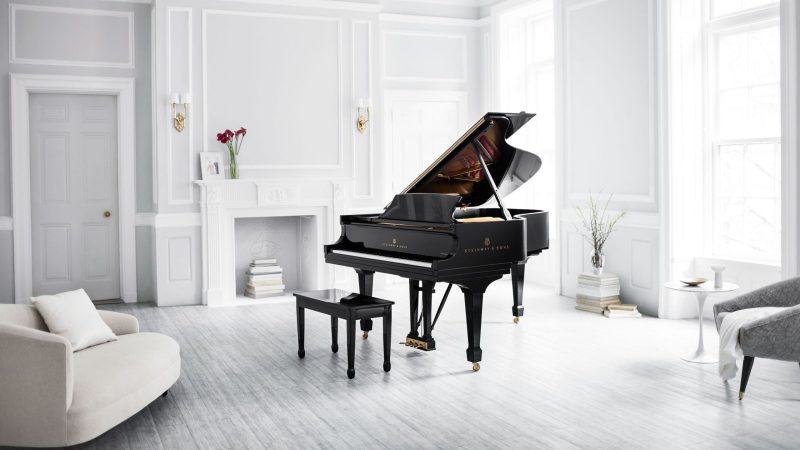
The Steinway Model B grand piano, sometimes referred to as "the perfect piano" is Steinway & Son's 7' class grand piano that has influenced piano design for more than a century, and been a musical favorite of concert pianists for nearly as long. It is considered one of the top 10 7' grand pianos in the world, and for most of the 20th century, was the undisputed leader of the industry. It is also a prime example of musical instruments and consumer goods taking a dramatic leap forward in design and complexity as a result of the industrial revolution, and the new economic era that it brought to most of the world. Merriam Pianos recently acquired a relatively new Steinway & Sons Model B grand piano, and Stu Harrison, Sales Director and Professional Pianist, will take you through the model's history, its sound, and what makes it one of the Top 10 most sought-after instruments in the world.

The Steinway Model B Grand Piano Review - Video Transcription

Piano Background
Steinway Model B

For more than 100 years the Steinway Model B has been the benchmark by which most 7-foot concert hall grade pianos are measured, and certainly the 'B' can be found in teaching studios, recital halls, fine homes, and recording studios the world over.

And there's a good reason for that level of reverence. If we go back to piano design in the late 1800s, where piano-making was still very much in an experimental phase, you had instruments coming out with different sets of keys, pedals, and a great variety in overall design. There were some with 85 keys, some with 88 keys, or some with two pedals, three pedals, four pedals. And lots of variation in the total number of strings, bridge configuration, and scale design. Generally, the piano industry was showing lots of experimentation and innovation from most of its major manufacturers. Even best practices in terms of design and manufacture of action parts were not uniformly agreed upon.
This was an industry still very much in its infancy, with lots of drive to continue improving and innovating the product category. And in amongst that climate of growth and innovation, as well as American ascent within the world community, Steinway set up shop in New York and started, one by one, chipping away at the technical challenges that were still plaguing piano design in 1853.

From the 1860s, '70s, and '80s, (as Steinway dealers will usually quite enthusiastically remind us of), there were hundreds of patents that were filed for this piano. And Steinway was solving a lot of the problems of the day and improving piano design, to point where they really did give us the basis for what pianos looked like throughout the 20th century.

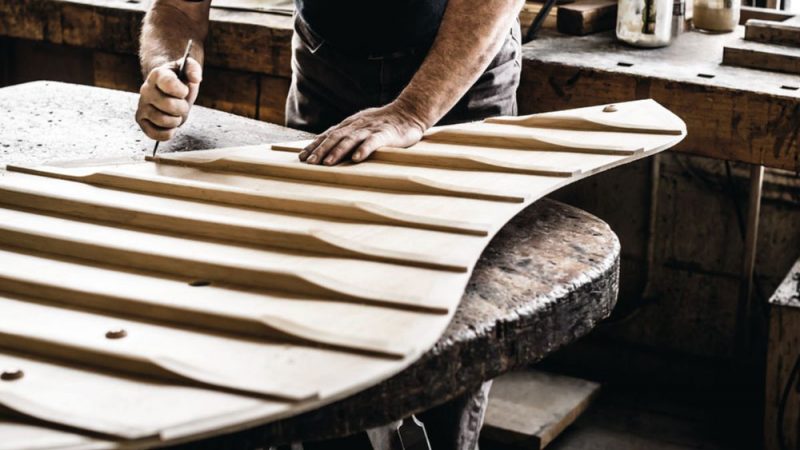
And so, of course, Steinway deserves a ton of credit for that. Not just for the advances in design, but for setting a new standard for piano craftsmanship as well. Their use of - and pioneering of - the diaphragmatic soundboard using quarter-sawn solid spruce with a very high degree of selection added to the industry dominance as well. A lot of those innovations that are now more than 100 years old still have application in today's piano market and today's piano design paradigm.

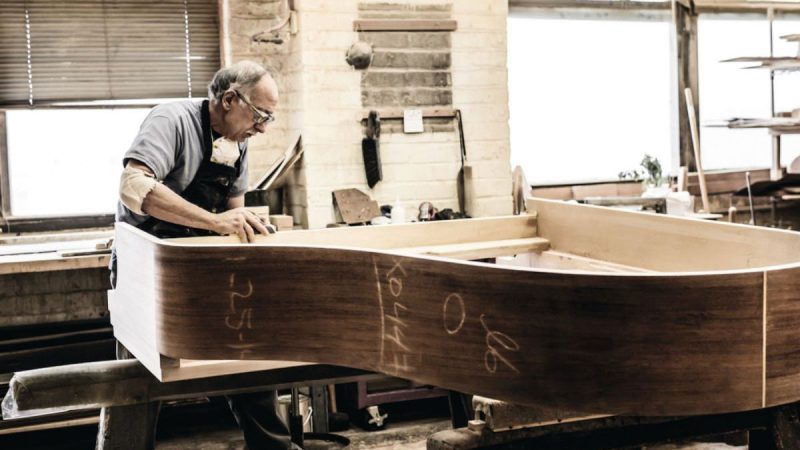
Each Steinway & Sons piano is composed of over 12,000 parts, and "the perfect piano" takes over a year to create. In the New York and Hamburg Steinway factory, everything is governed by the philosophy of company founder Henry E. Steinway “to build the best piano possible” – back then, and today.

The scale design has been around for quite a while. And this instrument, like several of the other models, have some really interesting design features, construction features to it. Like all the Steinway grands, their inner and outer rim is constructed in a single laminating process of hardrock maple.

Design Features & Innovations

Steinway Design Features

Any musician who works with instruments where wood is part of the primary resonating surface, like a drum or, of course, string instruments that also applies to, will tell you that the type of wood, the thickness of the wood, how the wood is dried, has a really big impact on the tone that the instrument (or in this case the piano) presents. And Steinway making the decision to use solid hardrock maple ,and also the decision to fuse both the inner and outer rim together really in one construction process, has given Steinway one of the hallmark tonal traits, which is this almost impossible to distort mid-range clarity that a lot of other instruments even when they have tried for that tone have been unsuccessful in attaining.

Hard-rock Maple

Steinway Hard-rock Maple

And so, the fact that they're using the hardrock maple gives the piano and incredible projection. Other instruments made of this type of wood, a lot of drum makers use hardrock maple, will talk about the projection and talk about the clarity that maple brings because it doesn't really distort even when you're putting a lot of energy through those fibers.

For a piano initially built for power, and clarity, and dynamic range, which the Steinway definitely was, maple was an ideal choice. And so, they're using maple in the bridges, vertically laminated maple and maple cap. You're using maple through the rims. There is without a doubt, no other way to describe a Steinway piano other than this piano is...if you wanted to know what maple sounded like, you just need to listen to a Steinway grand piano.

It really has a massive influence over what's going on in the tone. And a lot of people don't necessarily think about that. And the reason I'm making a big deal of this is when we then listened to the Bechstein or when you're comparing Steinways to other pianos, if you look at it through a constructional lens, the difference in the woods that are used, all of a sudden you start to realize why there's such a big difference in sound, and why there's such a big difference in projection or dynamic range for instruments using maple versus non-maple.

Soundboard and Treble Bell

Steinway Soundboard

Another interesting aspect to the B (or the D for that matter), is the application of the Treble Bell, an invention which helps to preserve crown in a very difficult spot on the soundboard to achieve it in the first place. The Treble Bell actually helps to "bend" the rim ever so slightly to pinch the soundboard inwards, giving it an extra millimeter or so of curvature (crown) - helping projection and tuning stability in that area of the piano. You'll see this treble bell present even on special models like their crown jewel collection, Spirio collection, or the Louis XV models. However, their shorter models like the Model S or Model M do not make use of it.

Sometimes when people are looking at Model B's and Model D concert grand's, and the piano is sounding a little bit dead or the trebles don't feel like they're really projecting that well, often the thing that really, really expert technicians will then go in and start to adjust, please do not do this at home. But the expert technicians will start to adjust is actually that bell. That's one of the biggest influences over how to get the top-end of a Steinway speaking really well.

Of course, Steinway became really famous as well for the control and the dynamic range that their action produced and the accelerated action was one of the big innovations in this area. So you get an instrument that is very responsive, has a really fast repetition speed on the action, and a piano that rather famously almost doesn't seem to have a top-end in terms of its dynamic range.

Hexagrip Pinblock

Common across the entire line is also the Hexagrip pinblock, which sets the tuning pins into 7 laminations of hard-rock maple and helps to preserve pin torque at very close to the factory original even decades after use. Amongst the various innovations that Steinway promotes as 'critical', the Hexagrip pinblock is something that most piano technicians generally agree set a high bar that the rest of the industry then followed.

The Steinway Sound

Steinway Sound

A great sounding Model B and certainly always a solid choice for somebody looking for an instrument capable of a lot of tonal range, a lot of dynamics.

And that applies to somebody thinking about a recording studio, a finer instrument for your home, a church or, of course, an institution. That said, just because Steinway was able to correct a lot of the failings of older piano design and give us an instrument that was capable of a ton of dynamic range, and accelerated action, and a lot of clarity in the mid-range, where other instruments had previously failed to deliver that, certainly does not mean that there is no room for further evolution in the design of pianos.

You can keep pushing a really great Steinway more and more and more and more and you never really hear it hit the ceiling. And so that's a combination of a lot of the things I've just talked about along with a lot of other minute design details that for those who are really keen, you can go in and you can do a little bit more research. So the bottom line is here's a perfect piano that has literally changed history, that we owe a lot to, and has a really distinctive tonal sound and projection.
And a lot of that is not coming from the fact that it says "Steinway." What I mean by that is that the 'Steinway sound' came from very specific designs, not just great branding or a better level of craftsmanship than was common in the industry. And a lot of that has to do with the fact that they were using maple, that it has this treble resonating bridge, and that it's using a high-tension scale design. And the whole thing is designed to just produce this incredibly clear, projecting, sustaining mid-range focused tone.

Major Competitors

The top 7' grand piano models that most shoppers will compare to a Model B include the C. Bechstein B212, the Bosendorfer 214, the Fazioli F212, and to a lesser extent, the Shigeru Kawai SK6 or the Yamaha CF6. Of these, the C. Bechstein B212 is the closest in design philosophy to the Steinway, though it has pushed forward in terms of technology and precision in both design and manufacture. Fazioli as well is known for extremely precise cabinetry and use of technology in its building processes.

There is also some debate amongst piano aficionados over whether the New York Steinway factory is the better piano vs the Hamburg Steinway factory - both of which produce a Model B with some subtle differences. For most industry watchers, the differences in the factories are best seen in their quality control, vs major differences in parts or material, and historically speaking the Hamburg has been favoured as the better instrument. However restrictions by Steinway on how North American customers can access Hamburg product has made it more difficult to access - and it certainly should be mentioned that NY Steinway Model B's come voiced very very differently than then Hamburg B's, which are typically brighter.

Conclusion

So in conclusion, the Steinway Model B continues to be a relevant, respected grand piano even a 100 years after its initial primacy in the market. The clear, projecting sound is due to a combination of design, the extensive use of maple in the frame and bridge, and overall a use of high quality materials, and of course overall build quality means that a Steinway grand sticks with us for a century or more.

One of the great ironies of Steinway & Sons in 2019 is that they generally rely on a narrative of tradition, heritage, hand-crafted manufacturing, and a brand and company not swayed by the latest trends and fads. However, the only reason we even know the name Steinway all around the world was that they were the trailblazers, the rule breakers, and the ones innovating at the head of the curve almost 150 years ago. They have now ceded that role to companies like Ravenscroft, C. Bechstein, Stuart & Sons, and Fazioli, who have objectively moved the bar for what a piano is capable of surely past what Steinway produces. But for people still enchanted with the brand, actual musical performance is only part of the appeal.

The post Steinway B: Review of the Steinway Model B Classic Grand Piano by Merriam Music first appeared on Merriam Pianos